
HBOT: YOUNGER UNDER PRESSURE
It cures the bends, rescues diabetic feet, and reverses carbon monoxide poisoning. So why does the case for oxygen as a fountain of youth rest on 35 people and no placebo?
TLDR
What it is: hyperbaric oxygen therapy, or HBOT, has you breathing pure oxygen inside a sealed, pressurized chamber, which forces far more of it into your blood and tissues than the lungs can manage alone.2
What's real: it is well-established hospital medicine, approved for a range of recognized conditions.2
What's oversold: the anti-aging headline rests on a single 35-person trial with no control group, run by a team that also sells the therapy.3
Intervention reality: the one rigorous placebo-controlled trial, on a chronic condition rather than aging itself, found no benefit across 84 patients.1
Protocol: 60 daily 90-minute sessions at twice sea-level pressure, five days a week for about three months.
Cost: roughly $150 to $650 a session, or $45,000 to $60,000 for the flagship anti-aging program, not covered by insurance.
Farview Longevity Score: 1.8 out of 5.
Welcome back, and thanks for sticking around for the second issue. This time we're stepping into the hyperbaric chamber, one of the few longevity tools that already earns its keep inside hospitals. That track record is tempting, but warrants a hard look before you spend a small fortune chasing it. Let's separate what the oxygen genuinely does from what the clinics selling it would like you to believe.
WHAT IS IT?
In hyperbaric oxygen therapy, you breathe pure oxygen while sealed inside a chamber pressurized above the air we normally live in.2 The pressure is measured in atmospheres absolute, or ATA, where 1 ATA is sea level and 2 ATA is twice that, roughly the pressure you would feel 33 feet underwater.2 Squeezing oxygen in under pressure dissolves far more of it into the blood than the lungs could ever manage on their own, which is why it works for stubborn wounds, trapped gas bubbles, and poisonings.
The idea has been around a while. A British physician named Henshaw sealed patients in pressurized air back in 1662, and Paul Bert, the French scientist known as the father of hyperbaric physiology, mapped both its benefits and its dangers in the 1870s.2 The modern longevity pitch rests on a newer claim called the hyperoxic-hypoxic paradox, championed by Shai Efrati and Amir Hadanny, researchers at the Sagol Center for Hyperbaric Medicine in Israel.3 The claim is that repeated bursts of very high oxygen, followed by ordinary air, fool the body into mounting the same repair responses it would under low oxygen, rousing stem cells and the systems that clean up and rebuild damaged tissue. Two of the things those repair systems supposedly reach are telomeres, the protective caps on the ends of your chromosomes that fray as cells divide, and senescent cells, worn-out cells that stop dividing but refuse to die.
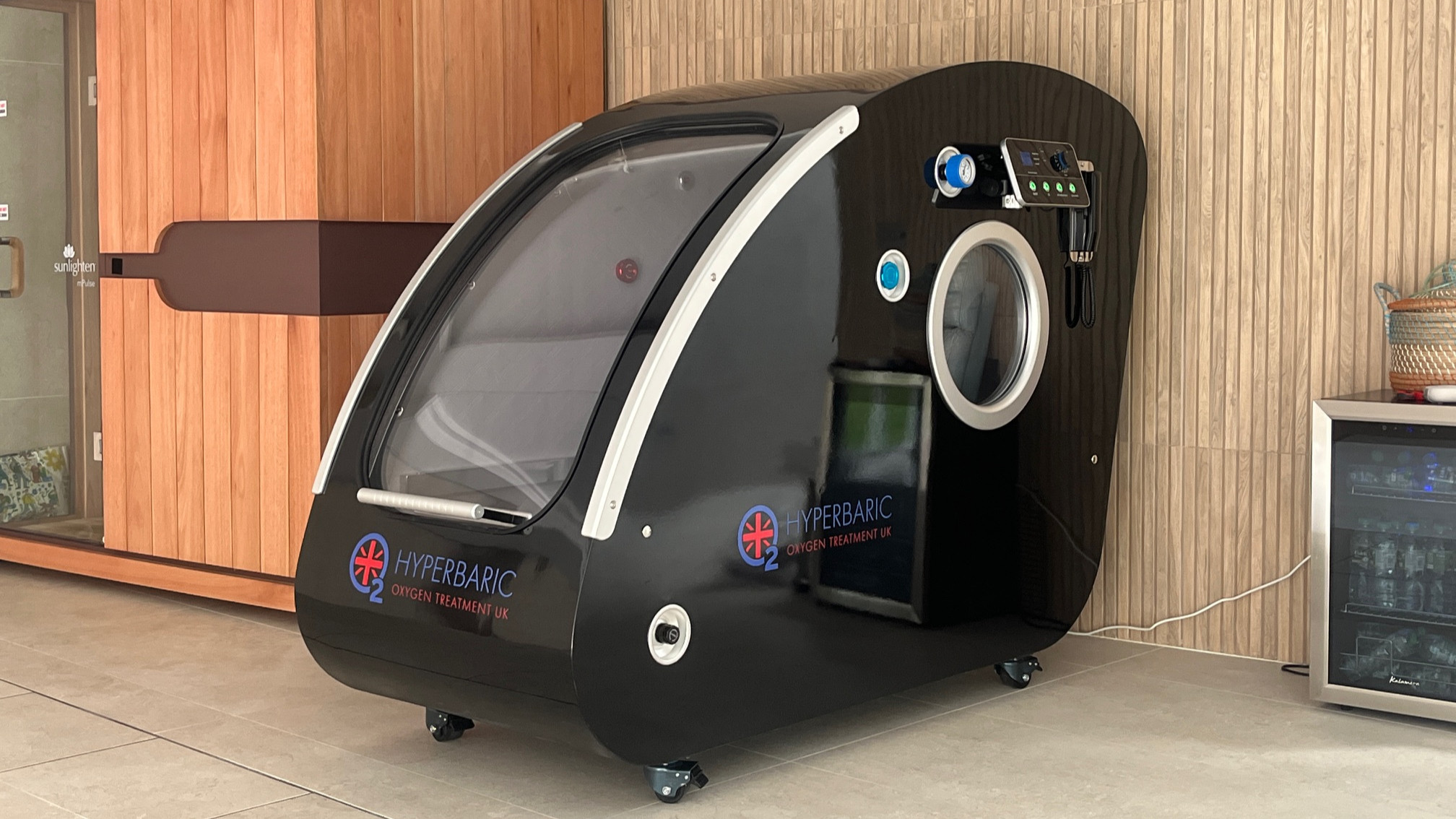
Source: Hyperbaric Oxygen Treatment UK, Hard Shell vs Soft Shell Hyperbaric Chamber
WHAT EVERYONE BELIEVES
Three claims come up over and over, usually as a set. The boldest is that hyperbaric oxygen physically reverses cellular aging, lengthening those telomeres and clearing out those worn-out cells, the kind of change most supplements can only dream of nudging. Close behind is the claim that it rejuvenates the aging brain, sharpening memory in healthy older people and even pushing back against Alzheimer's disease. The last claim is quieter and usually goes unspoken. Because hyperbaric oxygen is genuine hospital medicine with a long track record, people assume the anti-aging use rests on the same solid ground as the emergency-room use. If it saves limbs and treats the bends, the longevity data must be just as good. All three get repeated with real confidence across clinics, podcasts, and brochures. Whether they hold up is what the evidence section is for, and we will take them one at a time.
THE ACTUAL EVIDENCE
Start with the headline claim. The telomere result is real, and it is striking. In a 2020 study run by Shai Efrati and Amir Hadanny's group at the Sagol Center, 35 healthy adults aged 64 and older did 60 sessions, and the telomeres in their immune cells grew by more than 20%, with one cell type stretching by almost 38%.3 Aged, senescent immune cells dropped by up to 37%.3 For a three-month intervention, those are impressive numbers. The study had one basic weakness, though. It included no control group, which the authors themselves note, so there is no way to know how much of the change came from the oxygen rather than from time, testing, or chance.3 The sample was tiny, and the authors, Efrati and Hadanny among them, work for or hold shares in Aviv Scientific, the company that markets this exact protocol.3 A 2021 follow-up from the same team found real shifts in gene activity, including a longevity-linked gene called FOXO3, yet most of those changes had faded two weeks after the sessions stopped.4 The underlying biology is worth taking seriously, but a single uncontrolled trial cannot carry the anti-aging claim on its own.
The brain claim looks stronger at first. A 2024 systematic review by Lin and colleagues, published in Frontiers in Aging Neuroscience, pooled 11 trials covering 847 people with Alzheimer's disease and found meaningful gains on standard memory tests.5 But every one of those 11 trials was unblinded, meaning patients knew they were getting the treatment, which the reviewers themselves rate as a high risk of bias.5 Every one of the 11 trials was also run in China, with none reproduced by independent groups elsewhere. Many of the trials also combined hyperbaric oxygen with drugs rather than testing it alone.5
That leaves the quiet third claim, that a therapy approved in hospitals must also deliver as an anti-aging tool. One rigorous trial is the reason to be skeptical. When hyperbaric oxygen was finally tested the hard way, with a sham control group breathing ordinary air at low pressure so nobody could tell who got the real thing, it came up empty. That trial, called HOT2 and led by radiation oncologist John Yarnold at the Royal Marsden in London, gave 84 patients with chronic bowel injury after cancer radiotherapy a full course of 40 sessions.1 It found no benefit at all, contradicting decades of glowing anecdotes and non-randomized studies that had already made the treatment standard practice.1 An earlier trial had reported the opposite.1 The lesson is worth holding onto. The moment you add a proper placebo, effects that looked convincing can vanish.
DRAWBACKS AND CRITICISM
The therapy itself is usually well tolerated, but it carries real risks. The most common is barotrauma, pressure injury to the ears or sinuses, the same ache you feel on a descending flight.2 Temporary vision changes are surprisingly frequent. In the HOT2 trial, 16 of 53 treated patients had refractive shifts in their eyesight, though these usually reverse.1 Claustrophobia is common, and at high oxygen doses there is a small risk of oxygen-triggered seizures. Reassuringly, lung toxicity has not appeared under current protocols.2
The safety story took a sharper turn recently. In August 2025, the U.S. Food and Drug Administration warned health care providers that it had received reports of serious injuries and deaths involving hyperbaric chambers, driven by a heightened fire risk when oxygen runs at high concentration, with the root cause of the fires still unknown.6 This is not hypothetical. A 2009 clinic fire in Florida killed a four-year-old boy and his grandmother, and an exploding chamber killed a person in 2012.9
Then there is the money, tangled up with the science gap. Insurance covers hyperbaric oxygen only for its recognized medical uses, so the anti-aging version is not covered at all, and the bills are steep.7 A standard course runs several thousand dollars, and the flagship longevity program costs many times that.9 All of it sits on top of the deeper problem, that the aging evidence comes mostly from one group with a financial stake, Efrati and Hadanny's team at the Sagol Center, tied to Aviv Scientific.3
THE PROTOCOL
If you wanted to copy the anti-aging trials from Efrati and Hadanny's group, this is the course they ran.
Pressure. 2 ATA, about twice sea-level pressure, or the equivalent of 33 feet underwater.3
Gas. 100% oxygen, breathed through a mask.3
Session length. 90 minutes, broken up with a five-minute air break every 20 minutes, since the oxygen fluctuation is thought to be the active ingredient.3
Frequency. Five days a week.3
Full course. 60 sessions over roughly three months.3
Worth noting, the rigorous medical trial that found nothing used a slightly different setup, 40 sessions at a higher pressure of 2.4 ATA.1 The anti-aging version is the longer, lower-pressure one above.
ACCESS AND PROCUREMENT
Not all chambers are equal, and the difference decides whether you are getting the studied treatment or a lookalike. The research used hard-shell clinical chambers reaching 2 to 3 ATA on 100% oxygen. Soft-shell wellness studios usually top out around 1.3 to 1.5 ATA on concentrated rather than pure oxygen, a genuinely different and much milder exposure.7 Home chambers, at roughly $5,000 to $25,000, hit those same low pressures on ambient air, so they cannot reproduce the trials.7
When vetting a provider, the marker to look for is accreditation from the Undersea and Hyperbaric Medical Society, the field's professional body, whose stamp is recognized by hospital regulators as the quality benchmark.10 Per-session prices run roughly $150 to $650, higher at hospitals and lower at independent clinics, with package deals trimming the rate.7 Aviv Clinics, the operation most closely tied to this research, sells its full three-month program for roughly $45,000 to $60,000.8,9 Practically, the commitment is the hard part. Ninety minutes in the chamber plus travel, five days a week, for three straight months.3
The Farview Longevity Score
Every issue closes with this scorecard. Think of it as where the evidence stands today, not where an eager clinic promises it will land in a few years. Five axes, zero to five, where five is always the best case for you.
Why these scores
Sources
Glover M, Smerdon GR, Andreyev HJ, et al. Hyperbaric oxygen for patients with chronic bowel dysfunction after pelvic radiotherapy (HOT2): a randomised, double-blind, sham-controlled phase 3 trial. The Lancet Oncology. 2016;17(2):224–233.
Ortega MA, Fraile-Martinez O, García-Montero C, et al. A General Overview on the Hyperbaric Oxygen Therapy: Applications, Mechanisms and Translational Opportunities. Medicina. 2021;57(9):864.
Hachmo Y, Hadanny A, Abu Hamed R, et al. Hyperbaric oxygen therapy increases telomere length and decreases immunosenescence in isolated blood cells: a prospective trial. Aging (Albany NY). 2020;12(22):22445–22456.
Hadanny A, Forer R, Volodarsky D, et al. Hyperbaric oxygen therapy induces transcriptome changes in elderly: a prospective trial. Aging (Albany NY). 2021;13(22):24511–24523.
Lin G, Zhao L, Lin J, Li X, Xu L. Clinical evidence of hyperbaric oxygen therapy for Alzheimer's disease: a systematic review and meta-analysis of randomized controlled trials. Frontiers in Aging Neuroscience. 2024;16:1360148.
U.S. Food and Drug Administration. Follow Instructions for Safe Use of Hyperbaric Oxygen Therapy Devices: Letter to Health Care Providers. August 25, 2025.
HBOT Cost Guide 2025-2026: Treatment Prices and Insurance Coverage. BaricBoost. https://baricboost.com/hbot-cost/
Inhaling pure oxygen could keep your brain younger for longer. Popular Science. https://www.popsci.com/story/health/anti-aging-treatment-oxygen/
Is Hyperbaric Oxygen Therapy a Rip-off? NAD.com. https://www.nad.com/news/is-hyperbaric-oxygen-therapy-a-rip-off
Aviv Clinics. Brain Performance for Life. https://aviv-clinics.com/
Never miss a post
New research and interviews from the frontier, straight to your inbox.
Subscribe